


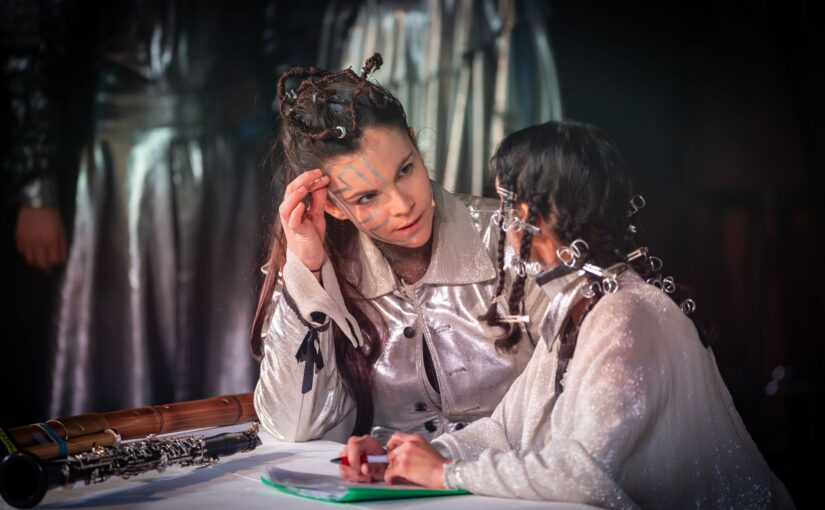
Evan Gardner is the artistic director of Opera Lab Berlin. Academically educated in modern composition in the United States, Gardner’s career eventually took him to Berlin, where he founded Opera Lab Berlin in 2013. POM Magazine is curious about this contemporary opera company. What is the ‘lab’ in Opera Lab, and what makes it unique? POM Magazine’s Klaartje Til talked to Evan Gardner, curious about his answers.
by Klaartje Til
Evan, did you ever imagine that you would end up where you are right now?
Well, I originally started music as a guitarist. One of my brother’s friends could play guitar and sing. I thought that that was so cool. I can’t sing though. I’m a horrible singer. I studied music later. At Oberlin College initially, but after my first year of college I got admitted to Oberlin Conservatory where I studied modern composition for about four years. It was a great programme full of post-World War II abstract work by composers like John Cage, Stockhausen and Morton Feldman. During my senior year I started to think about my life after graduation. I wanted to stay in abstract music. I didn’t want to go to Los Angeles and try my hand at pop music. Instead, I moved to Norway for a short stint, studying at the conservatory of Bergen and Oslo. During my stay in Norway, I went to Berlin for a weekend and I loved it. Within a year, I moved to Berlin where I worked as a freelance composer.
How did you get into opera?
I did a commission for Deutsche Oper. They held a competition for a one-act opera. I wasn’t really into opera up to that point. Opera does have a place in contemporary music, but it’s not the driving force. This opera commission enabled me to connect with a lot of students from the Hanns Eisler Conservatory here in Berlin and it offered the opportunity to form a group.
Was that the start of Opera Lab?
It was the beginning. A lot of people who took part in that commission became part of the original lineup of the Opera Lab collective. At first, we started off ever so clueless and dealing with all the practicalities: creating a website, managing a group, organising rehearsals, and so on. All these things took time to figure out. Once we handled all that, we could focus our energy and time on the larger questions about our position in the wider cultural context.
What does the creation process look like at Opera Lab?
When we started Opera Lab, we focused on a composer-director dynamic, where the composer and director would work closely together to create music theatre. In recent years, the director’s work is no longer assigned to one person but overlaps with the work of the other members of Opera Lab. We use everybody’s input in the opera productions. This gives everyone a piece of the pie in terms of ownership and authorship.
How does Opera Lab position itself?
We want our opera to convey something meaningful in the context of society as it exists at this moment. In our last production, ’You\Me/Alien‘, we worked with musicians from all over the world. The project was all about empathy, about understanding and about communication. It echoes the time we’re living in, where empathy is in low reserve. Society is politically fractured and the idea of immigrants is called into question.
Is that what makes an opera from Opera Lab different?
We’re working with different ways of making music, performed by people from all over the world. One of our operas featured a Hindustani classical singer, a Persian percussionist, a shamisen player [Ed. a traditional Japanese string instrument] and a quena flute player. The quena flute is a beautiful South American wooden wind instrument that has been around for centuries. The opera was a science fiction story that takes place on a spaceship with an alien lifeform on board, better said: an unexplainable phenomenon that we gave shape using lights and puppetry. We played off the science fiction tropes used in the 60s in the Star Trek TV series. The music was created by all the different musicians, reflecting the different qualities of sound that each musician brings into the opera. We used music as a form of communication with the alien phenomenon, that responds to music. That’s the basis for the narrative in this opera.
Do you think that Opera Lab will create a revolution within classical music?
Whether or not we succeed in bringing about a revolution remains to be seen.
As far as the future is concerned, we want to work on operas that are based on interesting ideas, are stageable and include beautiful performances that people genuinely enjoy. We offer an alternative take on opera that isn’t about Mozart, Verdi or Puccini. Don’t get me wrong, their work is beautiful, good stuff, but limited to the traditional view of classical music. So, along those lines, when I use a term like ‘revolution’, I mean opening up to all the good ideas that are out there in the world and then trying to find a way to integrate it in our projects.
Who is the audience of Opera Lab? What kind of audience do you have?
Our audience is highly diverse: independent theatre makers and people in that scene as well as people with various cultural backgrounds. Our marketing focuses on people who also visit clubs. We try to make our opera evenings the same kind of experience as going out on a Saturday night, targeting an audience who might, after our opera, go to Berghain or a different club, and dance all night. So, a combination of people active in theatre, traditional opera lovers, people of various cultural backgrounds, and clubbers.
How does Berlin influence Opera Lab?
Berlin has a highly dense cultural scene, of which we form a part. Berlin is home to at least seven major orchestras, three state-funded opera houses, and dozens of theatres. Amazing but also challenging. Opera funding is very much set in stone in Berlin. Luckily, Opera Lab falls in the domains of theatre and music, which enables us to apply for funding from both music- and theatre foundations. Our key advantage lies in the fact that we are an experimental lab, trying new things and doing things in different way. The fact that we also incorporate various cultural art forms, works in our favour. We want to do things that other organisations can’t do. That makes us unique.
What does the future hold for Opera Lab?
Our next production ’It’s Gonna Rain‘ uses the music of Steve Reich to explore how aspects of the American civil rights movement of the late 60s relate to the America, Berlin and other European cities of today. ‘Come out’, a famous piece of Steve Reich, was written in the 60s for a fundraiser in support of the Harlem Six, six young men who were wrongfully accused of murder. For Opera Lab music isn’t something we add to a theatrical concept. The opera ’It’s Gonna Rain‘ for example starts with real-world events of historical significance, but it doesn’t simply illustrate or reenact that history. Instead, the historical context feeds the creative process, while the music generates the dramatic formulation. ’It’s Gonna Rain‘ is set to premiere at the English Theatre Berlin in November 2026.