POM Magazine

POM Magazine, Magazine voor Stijl & Cultuur

POM Magazine

Opera Lab Berlin

Evan Gardner is the artistic director of Opera Lab Berlin. Academically educated in modern composition in the United States, Gardner’s career eventually took him to Berlin, where he founded Opera Lab Berlin in 2013. POM Magazine is curious about this contemporary opera company. What is the ‘lab’ in Opera Lab, and what makes it unique? POM Magazine’s Klaartje Til talked to Evan Gardner, curious about his answers.

by Klaartje Til

Evan, did you ever imagine that you would end up where you are right now?
Well, I originally started music as a guitarist. One of my brother’s friends could play guitar and sing. I thought that that was so cool. I can’t sing though. I’m a horrible singer. I studied music later. At Oberlin College initially, but after my first year of college I got admitted to Oberlin Conservatory where I studied modern composition for about four years. It was a great programme full of post-World War II abstract work by composers like John Cage, Stockhausen and Morton Feldman. During my senior year I started to think about my life after graduation. I wanted to stay in abstract music. I didn’t want to go to Los Angeles and try my hand at pop music. Instead, I moved to Norway for a short stint, studying at the conservatory of Bergen and Oslo. During my stay in Norway, I went to Berlin for a weekend and I loved it. Within a year, I moved to Berlin where I worked as a freelance composer.

How did you get into opera?
I did a commission for Deutsche Oper. They held a competition for a one-act opera. I wasn’t really into opera up to that point. Opera does have a place in contemporary music, but it’s not the driving force. This opera commission enabled me to connect with a lot of students from the Hanns Eisler Conservatory here in Berlin and it offered the opportunity to form a group.

Was that the start of Opera Lab?
It was the beginning. A lot of people who took part in that commission became part of the original lineup of the Opera Lab collective. At first, we started off ever so clueless and dealing with all the practicalities: creating a website, managing a group, organising rehearsals, and so on. All these things took time to figure out. Once we handled all that, we could focus our energy and time on the larger questions about our position in the wider cultural context.

What does the creation process look like at Opera Lab?
When we started Opera Lab, we focused on a composer-director dynamic, where the composer and director would work closely together to create music theatre. In recent years, the director’s work is no longer assigned to one person but overlaps with the work of the other members of Opera Lab. We use everybody’s input in the opera productions. This gives everyone a piece of the pie in terms of ownership and authorship.

How does Opera Lab position itself?
We want our opera to convey something meaningful in the context of society as it exists at this moment. In our last production, ’You\Me/Alien‘, we worked with musicians from all over the world. The project was all about empathy, about understanding and about communication. It echoes the time we’re living in, where empathy is in low reserve. Society is politically fractured and the idea of immigrants is called into question.

Is that what makes an opera from Opera Lab different?
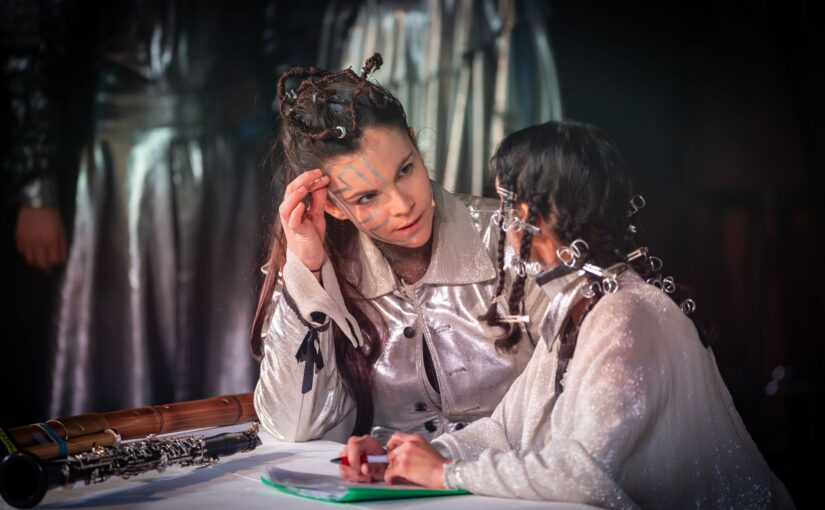
We’re working with different ways of making music, performed by people from all over the world. One of our operas featured a Hindustani classical singer, a Persian percussionist, a shamisen player [Ed. a traditional Japanese string instrument] and a quena flute player. The quena flute is a beautiful South American wooden wind instrument that has been around for centuries. The opera was a science fiction story that takes place on a spaceship with an alien lifeform on board, better said: an unexplainable phenomenon that we gave shape using lights and puppetry. We played off the science fiction tropes used in the 60s in the Star Trek TV series. The music was created by all the different musicians, reflecting the different qualities of sound that each musician brings into the opera. We used music as a form of communication with the alien phenomenon, that responds to music. That’s the basis for the narrative in this opera.

Do you think that Opera Lab will create a revolution within classical music?
Whether or not we succeed in bringing about a revolution remains to be seen.
As far as the future is concerned, we want to work on operas that are based on interesting ideas, are stageable and include beautiful performances that people genuinely enjoy. We offer an alternative take on opera that isn’t about Mozart, Verdi or Puccini. Don’t get me wrong, their work is beautiful, good stuff, but limited to the traditional view of classical music. So, along those lines, when I use a term like ‘revolution’, I mean opening up to all the good ideas that are out there in the world and then trying to find a way to integrate it in our projects.

Who is the audience of Opera Lab? What kind of audience do you have?
Our audience is highly diverse: independent theatre makers and people in that scene as well as people with various cultural backgrounds. Our marketing focuses on people who also visit clubs. We try to make our opera evenings the same kind of experience as going out on a Saturday night, targeting an audience who might, after our opera, go to Berghain or a different club, and dance all night. So, a combination of people active in theatre, traditional opera lovers, people of various cultural backgrounds, and clubbers.

How does Berlin influence Opera Lab?
Berlin has a highly dense cultural scene, of which we form a part. Berlin is home to at least seven major orchestras, three state-funded opera houses, and dozens of theatres. Amazing but also challenging. Opera funding is very much set in stone in Berlin. Luckily, Opera Lab falls in the domains of theatre and music, which enables us to apply for funding from both music- and theatre foundations. Our key advantage lies in the fact that we are an experimental lab, trying new things and doing things in different way. The fact that we also incorporate various cultural art forms, works in our favour. We want to do things that other organisations can’t do. That makes us unique.

What does the future hold for Opera Lab?
Our next production ’It’s Gonna Rain‘ uses the music of Steve Reich to explore how aspects of the American civil rights movement of the late 60s relate to the America, Berlin and other European cities of today. ‘Come out’, a famous piece of Steve Reich, was written in the 60s for a fundraiser in support of the Harlem Six, six young men who were wrongfully accused of murder. For Opera Lab music isn’t something we add to a theatrical concept. The opera ’It’s Gonna Rain‘ for example starts with real-world events of historical significance, but it doesn’t simply illustrate or reenact that history. Instead, the historical context feeds the creative process, while the music generates the dramatic formulation. ’It’s Gonna Rain‘ is set to premiere at the English Theatre Berlin in November 2026.

Opera Lab Berlin


Robert Henke-The computer based artist

At the music festival Rewire, Robert Henke played his work CBM 8032 AV, in a packed Royal Theatre in The Hague. On stage, there were five computers from the 1980’s. A large screen was hanging above the stage, displaying visual art and code that Henke used to start or stop music compositions on the computers. So, who is this man, who sits behind a desk on stage while typing on his keyboard? Did we hear the result of digital craftsmanship or does it take more to create that kind of music? Klaartje Til interviewed the ever friendly Robert Henke to find out the answers to these questions

By Klaartje Til

Mr. Henke, how would you define your art?
I am a computer based artist. It is a label that describes the main instrument that is at the core of my work: the computer. I don’t really know how to play a musical instrument and I can’t move a laser beam fast enough to draw visual laser art by hand. I need technology to create music, audiovisual art or visual art. The computer is the essential counterpart for my ideas.

What triggered or inspired you to get into computer based art, like electronic music?
If I have to point one singular piece of music that inspired me, it was the album “Oxygene” by Jean- Michel Jarre. It was released in the mid-seventies, and I was deeply impressed by the music. It opened an emotional engagement with sound, that I hadn’t experienced before. It made me realize that electronic music with synthesizers was, to a certain degree, within reach for me. I realized, that if I worked hard enough, I would be able to afford a synthesizer and I could try to make electronic music. So that was pretty much the starting point.

What role does coding play in the process of creating your music?
I have always used coding. It is a natural part of my artistic expression. I started with simple things. If I wanted to create a melody that only slightly changes every time you play it, I would build a system that involves some randomness. So after, for example, 3 notes, I might either move on to another 3 notes. Or I might move to a different direction and play a completely different set of notes. Then again, after 5 notes, I would make the decision to either repeat the first note and return to the second one, or stop. That is an example of a very simple system that can be run automatically and creates variations of a melody, while I can focus on something else. So the computer becomes my play partner. It starts to improvise, on top of which I can improvise. That is an example of how to use a computer to do something that is musically inspiring and helpful. When the software company Ableton started, the programming became more organized and a straight-forward process.

How did the company Ableton start?
I was born and raised in Munich, but decided to move to Berlin to study computer science. Against all odds, I met a person in Berlin who I already knew from Munich. He was a friend of a friend and I didn’t really like him. During one of the lectures at the university I saw this guy. We both looked at each other in disbelieve that of all the people, it had to be this person being there as well. Gerhard Behles and I became best friends. We started making music together and Gerhard became the driving force behind the founding of Ableton. The birth of Ableton was based on the fact that we knew that something was missing, some sort of tool. We were quite certain that among the people who make electronic music, there would be enough interest for such a tool. Enough to found a small company. That is how Ableton was born.

What did Ableton have to offer that was missing back then?
In the 80’s and 90’s, the main role the computer played in making music was the role of a recorder. This meant that you still had to play an instrument in order to make music with a computer. We don’t know how to play an instrument, and we didn’t need to because computers can do this better than we could ever do. We built a system that allowed people to interact with the computer in a playful manner. That concept of real-time interaction with software to create music did not exist in a commercial product, the way we did it. Now it is a standard feature that a lot of other software products offer. But the initial idea that something like this could work, came from us, from Ableton. I still work for Ableton and I am still part of the company. I have no intention to ever quit, because it is also the product of my imagination. So much of ‘me’ can be found in the software.

What role does the city of Berlin play in your artistic life?
I was lucky to move to Berlin in 1990, right after the fall of the Berlin wall. There was this fantastic void in the city. Life in Berlin was incredibly cheap and there were empty spaces everywhere. A lot of people used the opportunity to become creative and I was part of that scene. The scene in Berlin was very small and I got in touch with a record label that was looking for new artists. So I didn’t need to do much to get my first record out. That is how I became an electronic music producer. It just happened very naturally, by being the right person at the right time, in the right place.

How did your creative work evolve from coding behind a desk, to live performing?
A lot of music was actually created during concerts. We always record our live performances and the best stuff ends up on records. So performing and releasing music have always been one and the same to us. What did change over time were the visuals shown during the performance. I started to create the visuals for my performances myself. I wasn’t very happy with the visuals that VJ’s created during my shows. Most of the time they had nothing to do with my music and it simply didn’t fit. I decided to write my own little video generator, to have something running in the background. But soon I realized that I reached my limits, so I moved away from doing my own visuals.

Why did you reach your limits, you think?
At the time, there were a few people who did really amazing stuff. It was clear to me that I couldn’t reach their level. I thought it would be pointless to try to compete with them and I gave up. I returned to visual arts via a backdoor, when I was asked by a small gallery to do an installation and came up with the idea to do something with laser. This was about 14 years ago, when there were only a few artists who worked with laser in a way that I found interesting. It was unchartered territory where I could make an impact and do something that people hadn’t seen before.

Is that your main goal, to show people something they haven’t seen before?
I wouldn’t say that it is my goal and on the larger scale of things it is impossible to show something that hasn’t been seen before. But even though my work is not unique at first glance, it has its own qualities. It has depth, it has details and complexity. It is rewarding to experience my work multiple times because there are so many details to discover. It is rich. What I do is always rich. As far as my laser-work is concerned, I have the feeling that a lot of people who work with laser nowadays, are at least to some degree also influenced by what I have done. Because I often see things that remind me of stuff I did 10 years ago.

So you are the inventor of the kind of work you do?
In science and art, the question of who is first with something is always difficult to answer. Ideas never fall from the sky, they are connected to cultural backdrop and social environment. So it is not uncommon in science and art, that similar ideas pop-up at completely different places and at almost the same time.

Do you consider yourself a scientist as well?
I know enough about science to understand how far away I am from what makes a good scientist. But, like artists, a good scientist must have imagination to discover things that are not clear yet. In order to come up with a new theory about how things work, a scientist needs to be bold and needs to question the existing conditions. For engineers it is even more obvious, because they build something that has a function. If something has a function, it also consists of physical objects that need to be arranged in a physical space. There are multiple options to arrange the objects and design can help you to discover these options. I come from a family of engineers and the biggest liberation from my family background was that I understood that engineering is art. My family didn’t make the connection between engineering and art, but once I understood it is the same way of thinking, I felt liberated to do whatever I wanted to do.

This realization that engineering and art have a lot in common, how does it reflect in your creative process?
My work is a combination of logic and intuition. Most of the things I do require programming, which means that I have to solve problems in an abstract way. A lot of strict engineering thinking is involved, but ultimately the result is sound or graphics, or both. However, the best code doesn’t guarantee that the end result has an emotional impact. Technically it may be doing exactly what I was hoping it would do, but artistically it just isn’t interesting. In those cases, I add something that I don’t consider very important technically, and suddenly the magic is there. I find it fascinating that I can use technology to create something that transcends from a machine into something emotional and magic.

You use old-school monitors as well in some of your performances. Why do you work with these old-school computers?
Those computers are from 1980. They are insanely limited and working with them is very tedious, but it also means I have to think before I work. I cannot just program something and see what comes out. It brings a completely different focus and that’s why I like to work with these computers. The whole notion of art is that there is always a balance between the known and the unknown. If I use these old computers to create something that feels contemporary, then I have this nice juxtaposition between glitch electronic art from this millennium, and technology that is cute, tangible and outdated. This combination is very interesting.

Are you planning on doing something similar in the future?
Well, I am still working on this old project with the old computers. It is an ongoing project. I am still creating new sounds and new video material. I am touring with it as much as possible. It is a challenge to get these large, heavy old computers on tour, because they are fragile and expensive to bring along. But they are part of my live repertoire that people can book. So if you want to have the show and you have the money and the space, you can contact me and I can say: ‘Let’s go, let’s do it!

Subscribe to our newsletter

If you browse this website, you agree with the placement of cookies. More information Hide this message