


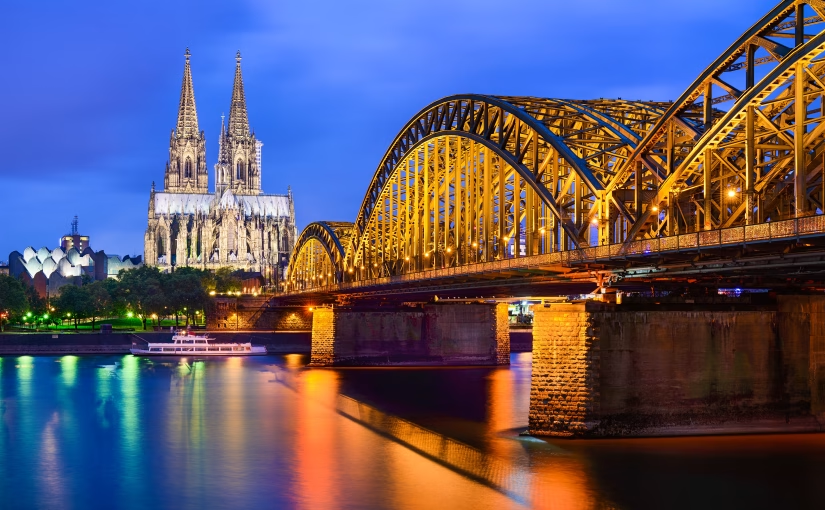
German journalist Frank Lorentz has lived in Cologne for 25 years. Before that, he spent years drifting from flat to flat, country to country and city to city. But once in Cologne, he decided to stay for good. Why? That is the question Klaartje Til put to Frank to find out what makes Cologne such a special city.
by Klaartje Til
Frank, after years of wandering through various cities and countries, why did you end up staying in Cologne?
I think I wanted to live in a large city, bigger than Düsseldorf. I was working there for a media company that offered me a job close to where I lived. I could have walked to the office. That was the moment I decided to move to Cologne. It sounds odd, but I would rather drive to work than walk.
If you compare Cologne to other German cities, does it stand out?
Cologne is a bit like Berlin. It is a little rough around the edges, not particularly beautiful and people dress in a relaxed, very informal way. In Düsseldorf, people are more smartly dressed. There is a high-society lifestyle in Düsseldorf. The mood is far more laid-back in Cologne.
What do you call people who come from Cologne?
In German, Cologne is called Köln, and there is a distinction between Kölner and Kölsch. Kölner are people who come from Cologne, but you can only call yourself Kölsch if you are at least the fifth generation of Kölner. Only then are you truly Kölsch.
I have never been to Cologne. If I were to visit, what would be the ultimate Cologne experience?
You should come by train while listening to electronic music, because Cologne is famous for its electronic music scene. You step off at Köln Hauptbahnhof, and as you leave the station you find the Cologne Cathedral right in front of you. Do not forget to admire the stained-glass windows created by the artist Gerhard Richter. He made them specially for the Cathedral. After your visit to the Cathedral, take a walk along the Rhine. Then catch an FC Köln match. On the last day of Carnival, Rosenmontag, make sure you see the carnival procession. After the procession, head to a Brauhaus and enjoy a Kölsch beer served in a narrow glass known as ‘Stange’.
Is there a distinct football culture in Cologne?
Absolutely. FC Köln is one of the biggest clubs in Germany and forever yo-yoing between divisions. My son saw his first FC Köln match when he was four years old. We watched the game in a café. FC Köln lost and were set to be relegated from the Bundesliga once again. When the final whistle blew, the people in the café were disappointed for about one second. Two seconds later the music was on and people were singing along. They were celebrating the fact that FC Köln would surely be promoted again one day. Of course, there are hooligans in Cologne who get angry when FC Köln loses, but most supporters celebrate winning and losing alike. Both are cause for celebration.
What role does the River Rhine play in Cologne?
Without the Rhine, the city simply would not be Cologne. In the south of Cologne, near Rodenkirchen, there are sandy beaches known as the Kölsche Riviera. On warm summer days, it is very tempting to take a dip in the Rhine. But there is a powerful and extremely dangerous undercurrent. It drags you down to the riverbed and you have no chance whatsoever. Swimming in the Rhine is therefore prohibited. The Rhine is ambivalent. It has two faces, a gentle face and a dark one.
You mentioned the Rodenkirchen neighbourhood. Are neighbourhoods important to Cologne’s identity?
Cologne is made up of so called ‘Veedel’, a kind of small village within the city that has everything you need: supermarkets, shops and restaurants. Cologne has around twelve ‘Veedel’, and together they form the city of Cologne.
Why is Cologne not really a beautiful city?
There is of course the magnificent Cologne Cathedral, which is Germany’s most visited monument and draws millions of tourists. Cologne was heavily bombed during the Second World War. I believe around 95 percent of the city centre was destroyed at the time, and the vast majority of the historic inner city was lost. After the war, everything was rebuilt at the lowest possible cost. That is why the city centre of Cologne looks the way it does today. But you know, the people make Cologne, not the buildings. The buildings do not really matter. Except for the Cologne Cathedral, of course.
How do the people make Cologne what it is?
The people of Cologne are open-minded and will strike up a conversation with you straight away. Getting to know them couldn’t be easier. They love their city and you can hear that love in the Cologne carnival songs. There is a song called, Hey Kölle! Du bes e Jeföhl, which translates as Hey Cologne! You are a feeling. It is by the Kölsch band Höhner. That is what Cologne is, a feeling, not buildings or tourist attractions, but a feeling. Incidentally, the FC Köln club anthem is also by Höhner. It is called Mer stonn zo dir, FC Kölle. This music is Kölsch, FC Köln is Kölsch, and of course the local beer is called Kölsch too.
What makes Cologne unique?
The German football coach Jürgen Klopp once answered a question at a press conference about what kind of coach he was by saying: I am the normal one. You could say the same about Cologne. Cologne is the normal one. Except for the Cathedral, Cologne is utterly ordinary.